Triathlon & TT
Recording Your bike Measurements
Getting your bike set up right means knowing your key measurements — not just guessing. Whether you’re dialing in your fit or switching bikes, having accurate reference points makes the whole process smoother.
In this guide, we’ll show you how to take the four main contact point measurements that matter most:
Saddle height
Saddle fore/aft
Reach to Pads
Drop to Pads
Let’s break down how to capture each of these points accurately.
- #1: Saddle Height
To measure your saddle height accurately, start from the center of the bottom bracket (BB) — that’s the middle of the crank axle. Measure in a straight line up to the top middle of the saddle, going through the central axis of the seat tube.
This method provides the most reliable and repeatable measurement, giving you a true saddle height you can reference across bikes or when making adjustments.
Tip: Use a tape measure and take the reading with the bike upright on level ground for best results.

- #2: Saddle Fore/Aft (Setback)
Saddle setback refers to how far behind the bottom bracket your saddle sits. It’s a critical measurement that influences your pedaling efficiency, comfort, and how your body weight is distributed over the bike.
To measure it, you’re essentially finding the horizontal distance from the tip of the saddle to a vertical line that runs through the center of the bottom bracket.
There are two easy ways to do this:
Method 1 – Spirit Level + Tape Measure
Place a long spirit level on the saddle, making sure it’s level. Drop a tape measure or plumb line (string with a weight) from the saddle nose to the ground, and mark that spot. Then measure the horizontal distance from that point back to the bottom bracket axis.Method 2 – Plumb Line + Tape Measure
Hang a weighted string (a plumb line) from the tip of the saddle so it drops straight down. Without needing a spirit level, use a tape measure to measure the horizontal distance from the plumb line to the center of the BB. Same result, just a simpler setup.
This gives you your saddle setback — the horizontal distance behind the BB that your saddle is positioned. It’s a key number to track when changing saddles or seatposts to maintain a consistent position.

- #3: Reach To The Pads
To measure reach to the pads:
Place a straight edge (like a meter ruler, level, or even a broomstick) across the tops of middle area of both pads – this represents the line we’re measuring to, like the red line shown in the diagram below.
Use a tape measure to measure the horizontal distance from the tip of your saddle to the center / middle of the pads
This gives you your effective cockpit reach – not to the frame or the bars, but to where your elbows actually sit. It’s a great number to record and reference, especially if you’re dialing in your position or comparing setups.

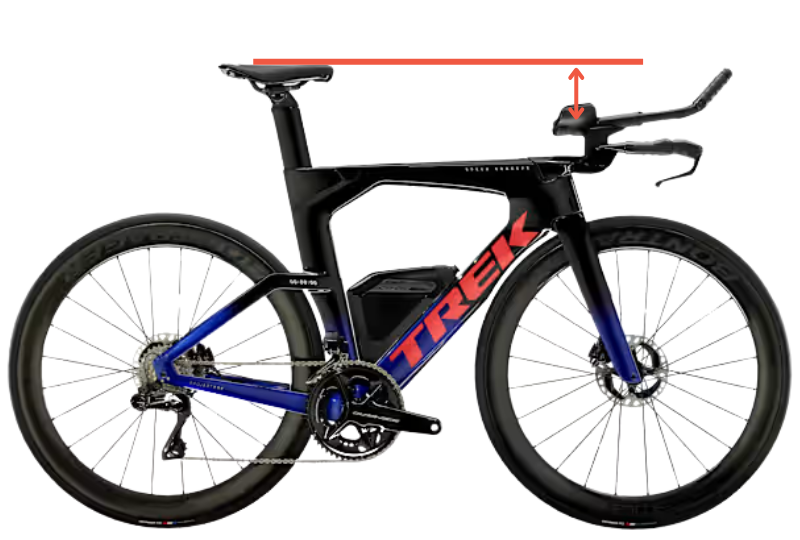
- #3: Drop To The Pads
The Drop to the pads is the vertical difference between your saddle height and the pad position. It affects your posture, weight distribution, and how aggressive or relaxed your front-end position feels.
There are two simple ways to measure this:
Method 1 – Spirit Level + Tape Measure
Place a spirit level on the saddle and hold it level over the pads, use a tape measure to check the vertical drop between the saddle and the top of the padsMethod 2 – Floor-to-Contact Point Method
Use a tape measure to:Measure from the floor to the top middle of the saddle.
Measure from the floor to the top of the pad
Subtract the pad height from the saddle height to get your drop to pads.
Both methods work — use whichever is easier with the tools you have. Just be sure the bike is on level ground and upright for accuracy. This measurement is especially useful when trying to match your position between bikes or fine-tune front-end comfort.